Indeed, beyond their physical reality, the territories of Israel/Palestine have constituted a schematic description of a conceptual system whose properties have been used to understand other geopolitical problems. The ‘Intifada’ unfolding in Iraq is a part of an imaginary geography that Makram Khoury-Machool called the ‘Palestinization of Iraq’. Yet, if the Iraqi resistance is perceived to have been ‘Palestinized’, the American military has been ‘Israelized’.
Furthermore, both the American and Israeli militaries have adopted counter-insurgency tactics that increasingly resemble the guerrilla methods of their enemies.
When the wall around the American Green Zone in Baghdad looks as if it had been built from left-over components of the West Bank Wall;
when ‘temporary closures’ are imposed on entire Iraqi towns and villages and reinforced with earth dykes and barbed wire;
when larger regions are carved up by road blocks and checkpoints;
when the homes of suspected terrorists are destroyed, and ‘targeted assassinations’ are introduced into a new global militarized geography
...it is because the separate conflicts now generally collected under the heading of the ‘war on terror’ are the backdrop to the formation of complex ‘institutional ecologies’ that allow the exchange of technologies, mechanisms, doctrines, and spatial strategies between various militaries and the organizations that they confront, as well as between the civilian and the military domains.
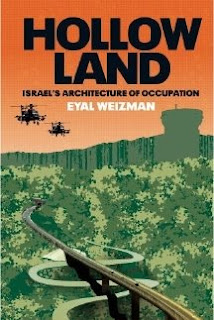
Eyal Weizman. Hollow Land: Israel’s Architecture of Occupation (Verso, London, 2007), p. 10.this is what i'm presently reading... can't help but make the connections b/w current events in Gaza, my recent posts on Israeli incursions into the Occupied Territories almost 7 years ago, and the links the author makes in the excerpt above (and i allude to in the previous post) b/w American and Israeli approaches to the 'War on Terror.'
note: i've broken up the excerpt for easier reading... it's all one long paragraph in the book.

